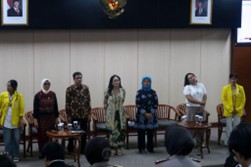
The Faculty of Humanities, Universitas Indonesia (FIB UI), organized a public lecture titled “Learning from the Nation’s Wounds: Sexual Violence in the Reform Era and the Rise of the Younger Generation” as the culmination of the MeiLawan: Preserving Memory series on Wednesday, 13 May 2026. The event was attended by students, alumni, academic staff, public officials, and cross-sector speakers directly connected to the May 1998 events and issues of women’s protection.
The event opened with remarks from the Dean of FIB UI, Dr. Untung Yuwono, S.S., who emphasized the importance of preserving the nation’s collective memory. In his address, the Dean highlighted the need to remember the May 1998 tragedy, during which many women became victims of violence, ranging from harassment and rape to loss of life due to their involvement in the reform movement. He stressed that these painful experiences must serve as a reminder to prevent recurrence and that the campus must remain a safe, inclusive, and gender-sensitive space.
Following the Dean’s remarks, the Deputy Mayor of Depok, Chandra Rahmansyah, S.Kom., M.T., expressed appreciation for the faculty and alumni’s initiative in preserving historical memory. He emphasized the importance of cross-sector collaboration in maintaining social awareness, particularly regarding women’s protection and sexual violence issues.
Visna Vulovik, M.A., Chair of ILUNI UI FIB, explained that the MeiLawan activities represent a collaborative effort to preserve the memory of the May 1998 Tragedy, while also serving as a space for learning, discussion, and voicing humanitarian concerns that are often overlooked. She underscored the critical role of young people in fostering awareness of gender-based violence, discrimination, and marginalization, issues that remain relevant today, and in supporting the enactment of the Presidential Regulation on the Prevention and Handling of Sexual Violence in Educational Institutions.
Dr. Rieke Diah Pitaloka, M.Hum., Member of Commission XIII of the Indonesian House of Representatives (DPR RI), presented the surge of sexual violence cases in educational institutions due to abuses of power across levels. She emphasized that current handling is sectoral, lacking national standards, and regulations have not yet addressed integrated protection management. Data showed that in 2024, there were 573 cases of violence in educational institutions, increasing to 641 cases in 2025, with 57.65 percent involving sexual violence. At the beginning of 2026, emergency conditions indicated that 91 percent of cases in educational institutions were dominated by sexual violence, signaling that universal protection had not yet been achieved. Rieke stressed that establishing the Presidential Regulation is imperative to create integrated, gender-responsive, victim-centered governance, reinforced by national data and legal enforcement.
Other speakers included Dr. Maria Ulfah Anshor, Chair of the National Commission on Violence Against Women (Komnas Perempuan) 2025–2029, Dr. Amiruddin al Rahab, Commissioner of the National Human Rights Commission (Komnas HAM), the head of the undergraduate Philosophy studies program, FIB UI, Ikhaputri Widiantini, S.Hum., M.Si., and Brigjen Pol. Dr. Nurul Azizah, S.I.K., M.Si., Director of PPA-PPO Bareskrim Polri. The discussion was responded to by Sri Nurherwati, S.H., Vice Chair of the Witness and Victim Protection Agency (LPSK), and Davina Najwa Armaela Hoja from the Department of Strategic Studies and Action, Student Executive Board (BEM FIB UI) 2026. The session was moderated by Sarie Febriani, Senior Journalist from Kompas, who guided the discussion and Q&A.
The discussion emphasized the importance of preserving the collective memory of the May 1998 Tragedy, particularly sexual violence against women, while strengthening the role of youth in creating safe, inclusive, and violence-free social spaces in educational institutions.
As a symbolic closing, the series of activities featured an art installation representing the graves of the May 1998 victims. FIB students (BEM) performed a symbolic reenactment in front of the installation, posing reflective questions such as “Where is justice?” and “Where is the safe space?”. The event also included large banners to raise public awareness and a three-day exhibition of archival photographs from 1998 at FIB UI, providing visual and historical context to remember the tragedy.
Through this event, FIB UI hopes that students and the entire academic community will continue to cultivate critical awareness, empathy, and moral commitment toward victims of violence. The initiative aims for students to preserve the memory of this historical tragedy not merely as a reflection on the past but as a foundation for building an academic culture that is safe, inclusive, and gender-sensitive, encouraging young people to actively combat sexual violence and discrimination in society. (LS)