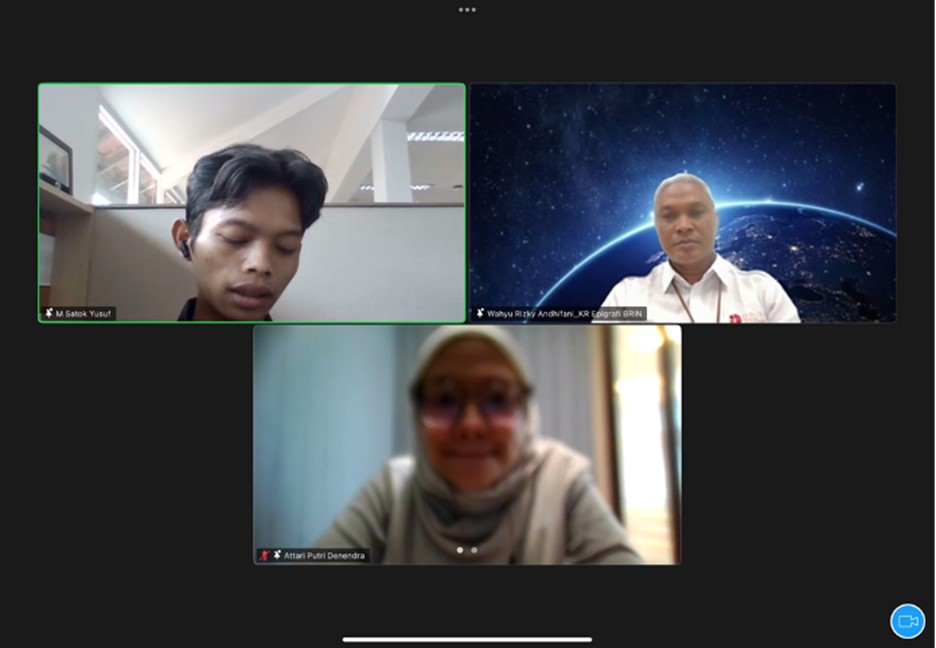
The Museum, Heritage, & Islamic Material Culture (MUSHIMAC) Research Group, Department of Archaeology, Faculty of Humanities, Universitas Indonesia (FIB UI) held its second webinar series titled “Islamic Art & Material Culture Studies” on Wednesday, May 6, 2026. The event was conducted online via Zoom Meeting as part of an effort to deepen the study of Islamic art and material culture in Indonesia—exploring how it was formed, how it developed, and how it continues to shape societal identity from the past to the present.
This second series was opened by Prof. Dr. Irmawati Marwoto, M.Hum., Professor of the Department of Archaeology FIB UI, and Chair of the MUSHIMAC UI Research Group. In her introduction, she emphasized that material culture is not just about objects; it is an entry point to reading various social, political, and cultural phenomena that often go unnoticed. The webinar featured two speakers and was moderated by M. Satok Yusuf, S.S., M.Hum., a lecturer at the Department of Archaeology, FIB UI.
The first presentation was delivered by Dr. Wahyu Rizky Andhifani, S.S., M.M., Junior Expert Researcher from the BRIN Center for Prehistoric and Historical Archaeology Research, titled “Regulated Bodies, Institutionalized Power: Reading the Piyagém of the Palembang Darussalam Sultanate.” Using Michel Foucault’s framework on the relationship between the body and power, Dr. Wahyu reviewed the piyagém—official charters of the Palembang Darussalam Sultanate written on copper plates—as instruments for regulating the social life of the community.
His study focused on four main rules contained in the piyagém: the obligation to plant pepper, trade prohibitions associated with Buddhist practices, marriage restrictions, and regulations regarding physical abnormalities. Through these rules, the Sultan not only managed political and economic affairs but also reached into the most private realms of his subjects’ lives. It is also interesting to note that the piyagém utilized Javanese script and language in the Uluan region, while Malay script was used in the capital—a linguistic phenomenon reflecting the complexity of culture and power in the region. Physical remnants of that power, such as the Palembang Great Mosque, still stand today as a reflection of the sultanate’s historical influence.
The second presentation was given by Attari Putri Denendra, S.Hum., a graduate of Archaeology FIB UI, titled “Life-Course and Biography of Things: Minangkabau Women’s Headgear.” By combining the Biography of Things paradigm and Life Course theory—which differs from a simple life cycle—Attari invited participants to see headgear not merely as an accessory, but as a living marker of identity that changes along with the wearer’s life journey.
Through the analysis of historical photographs and literature, she demonstrated how various types of headgear are worn at different stages of life—from aqiqah ceremonies and khatam Al-Qur’an to religious education environments. In the Minangkabau tradition, headgear serves as a marker of age, marital status, and life transitions; a form of identity performativity stored within material culture objects.
The Q&A session was met with enthusiasm. Participants asked various questions, ranging from the possibility that rules in the piyagém were continuations of pre-Islamic traditions, the ways the sultanate regulated life down to the most personal levels, to the diversity of headgear across various regions of Sumatra, and concerns over the increasing rarity of these traditions in modern society.
Through this webinar, MUSHIMAC UI reaffirms its commitment to remain a space for publication and discussion for Islamic material culture research in Indonesia, studied through various fresh paradigms that have rarely been touched upon in Indonesian archaeological discourse until now. (MUSHIMAC Department of Archaeology FIB UI) (Trans-RMRW)