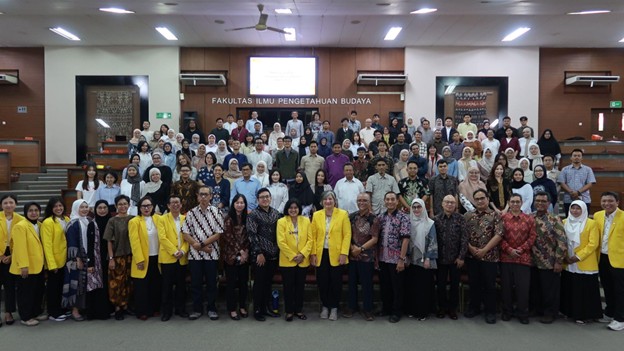

The Faculty of Humanities at Universitas Indonesia (FIB UI) has once again conferred a new doctoral degree in History, introducing a significant contribution to contemporary political-cultural history. On Thursday, 9 July 2026, a doctoral promotion session was solemnly held at the Tjan Tjoe Som Auditorium, Hoesein Djajadiningrat Building (1st Floor), FIB UI. The academic session was chaired by Prof. Dr. Agus Aris Munandar, S.S., M.Hum., where Adhitya M. Maheswara successfully defended his dissertation and graduated with the distinction of “Very Satisfactory” (Sangat Memuaskan). He is officially recorded as the 497th doctoral graduate from the Faculty of Humanities, Universitas Indonesia, and the 7th graduate from the History Doctoral Program.
The examined doctoral dissertation is titled “Strategi Pemerintah Amerika Serikat dalam Pembingkaian Agenda Perang Melawan Teror Pasca-Serangan 9/11 (2001-2010)” [The United States Government’s Strategy in Framing the War on Terror Agenda Post-9/11 Attacks (2001-2010)]. This comprehensive research was supervised by Prof. Dr. Zeffry, S.S., M.Si. as the Promoter, alongside Agus Setiawan, S.S., M.Si., Ph.D. as the Co-promoter. Serving on the Board of Examiners for this session were Dr. Abdurakhman, S.S., M.Hum. as the Chair of the Board of Examiners, with committee members consisting of Prof. Dr. R. Tuty Nur Mutia, S.S., M.Hum., Dr. Yuda Benharry Tangkilisan, S.S., M.Hum., Dr. Dwi Mulyatari, S.S., M.A., and Dr. Iwan Gunawan, S.Sn., M.Si. Before the board of examiners, Dr. Adhitya M. Maheswara successfully presented a historical reconstruction demonstrating how a foreign policy agenda was systematically woven through entertainment media.
The study reveals that the terrorist attacks of September 11, 2001, served as a crucial turning point in United States foreign policy, giving rise to the “War on Terror” agenda under the administration of President George W. Bush. Rather than relying solely on conventional bureaucratic channels, US state and military institutions leveraged their long-standing historical relationship with the entertainment industry to propagate political narratives. Utilizing critical historical methods, this research reconstructs the deliberate framing efforts designed to establish strong narrative connections among the 9/11 attacks, Osama bin Laden, Saddam Hussein, the urgency of the Iraq invasion, and the critical issue of weapons of mass destruction (WMDs).
The primary findings of this study assert that the United States government capitalized on post-attack collective trauma to mobilize domestic and global public support for military interventions in Afghanistan and Iraq. Applying the analytical lenses of Randal Marlin’s propaganda techniques, Stuart Hall’s representation theory, and Maurice Halbwachs’ collective memory framework, this dissertation demonstrates how Hollywood films and militaristic video games worked effectively as propaganda instruments to secure patriotism and legitimize military aggression. This phenomenon gave rise to what is termed militainment—a potent fusion of entertainment and militarism that heavily dictated the global public perception toward Muslims and the Arab world in the modern era. (AR)