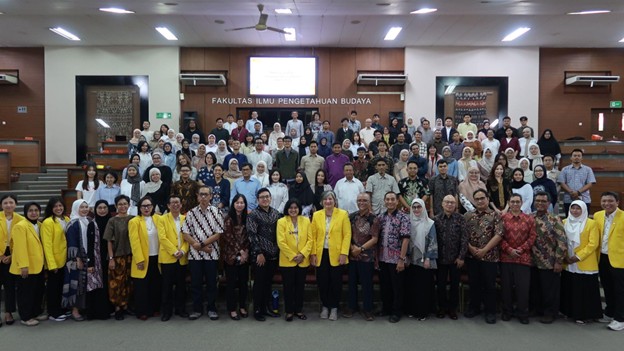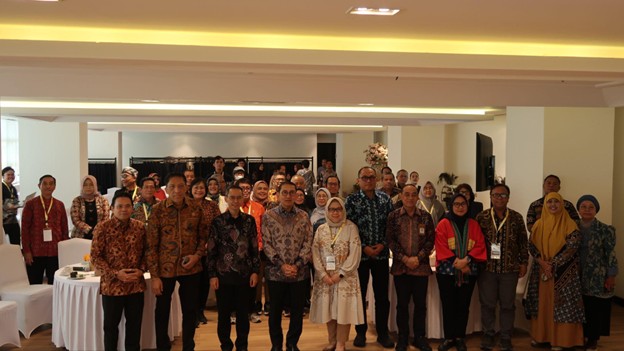
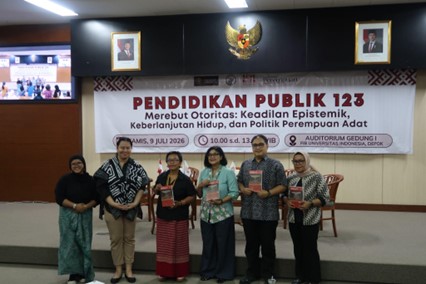
On Thursday, July 9, 2026, Jurnal Perempuan hosted a public lecture titled “Reclaiming Authority: Epistemic Justice, Sustainability of Life, and the Politics of Indigenous Women” at the Toeti Heraty N. Roosseno Auditorium, Faculty of Humanities, Universitas Indonesia (FIB UI).
Moderated by Alifia Putri Yudayanti, S.Hum., from the editorial board of Jurnal Perempuan, the event brought together prominent experts and activists: Dr. Harsawibawa Albertus, S.Sn., M.Hum. (FIB UI lecturer); Maimuna Renhoran, S.H., M.H.; Prof. Dr. Dra. Ani Widyani Soetjipto, M.A.; and Putri Nurfitriani, M.Hum. The lecture shed light on the critical need to recognize the rights of indigenous communities—particularly indigenous women—not only as mere cultural custodians but as active producers of knowledge, community leaders, and vital authorities in safeguarding ancestral domains and life sustainability.
The event commenced with opening remarks from Lily Tjahjandari, S.S., M.Hum., Ph.D., the Vice Dean for Resources, Venture, and General Administration of FIB UI. In her address, Dr. Tjahjandari highlighted the ongoing discrimination and systemic threats faced by indigenous peoples, emphasizing how these challenges deeply jeopardize the resilience and continuity of Indonesia’s rich, diverse cultural heritage. Opening remarks were also delivered by Patricia Beata Kurnia, M.Si., Editor-in-Chief of Jurnal Perempuan, and Rukka Sombolinggi, Secretary-General of the Indigenous Peoples Alliance of the Archipelago (AMAN).
During the panel discussion, Dr. Harsawibawa Albertus, S.Sn., M.Hum., a Philosophy lecturer at FIB UI, underscored how indigenous knowledge is frequently marginalized or deemed invalid due to the dominance of Western paradigms in mainstream knowledge production. Following this, Maimuna Renhoran, S.H., M.H., a lecturer at the Tual State Fisheries Polytechnic, discussed how gender constructs heavily influence the distribution of rights, authority, and resource access within indigenous groups. She emphasized that the collective recognition of indigenous rights does not automatically guarantee the fulfillment of individual rights for indigenous women.
Expanding on the lived realities on the ground, Putri Nurfitriani, M.Hum., from the Jurnal Perempuan editorial team, shared insights from her field research in Southeast Sulawesi. She exposed the devastating impacts of state repression and the destruction of indigenous living spaces, which have stripped communities of their livelihoods and inflicted severe psychological trauma. Complementing these findings, Prof. Dr. Dra. Ani Widyani Soetjipto, M.A., a Professor at the Department of International Relations, FISIP UI, stressed the urgency of a politics of recognition through national legal frameworks that are strictly gender-responsive.
The public lecture successfully encouraged participants to deepen their understanding of where indigenous women stand within Indonesia’s legal and political recognition frameworks. Ultimately, the event reaffirmed that indigenous women play a far greater role than just preserving cultural traditions—they are the key guardians of knowledge, environmental stewards, and protectors of their community’s future. This public lecture directly corresponds with the theme of Jurnal Perempuan’s 123rd edition, “Reclaiming Authority: Epistemic Justice, Sustainability of Life, and the Politics of Indigenous Women.” (AL)