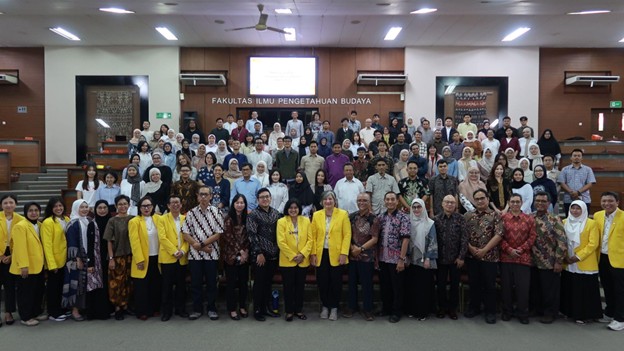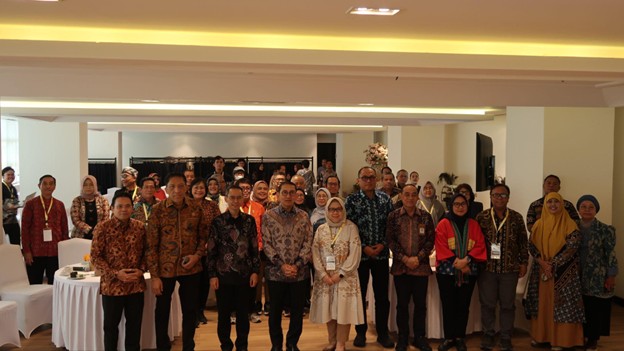
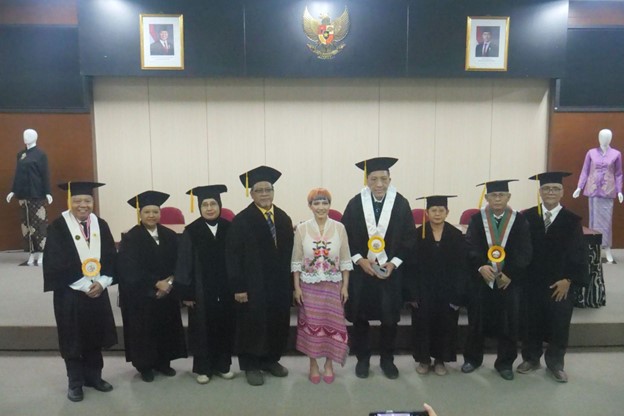
The Faculty of Humanities at Universitas Indonesia (FIB UI) has once again conferred a new doctoral degree in History, introducing a significant scientific contribution to the history of fashion and Indonesian cultural politics. In a solemn doctoral promotion session held on Wednesday, 8 July 2026, and chaired directly by Prof. Dr. Agus Aris Munandar, S.S., M.Hum., Lenny Agustin Ernawati successfully defended her dissertation and graduated with the distinction of “Very Satisfactory” (Sangat Memuaskan). She is officially recorded as the 496th doctoral graduate from the Faculty of Humanities at Universitas Indonesia and the 6th graduate from the History Doctoral Program in 2026.
The examined doctoral dissertation is titled “Kebaya Modern Sebagai Busana Nasional Wanita Indonesia pada Era Orde Baru: Relasi Kuasa, Politik Kebudayaan, dan Tubuh Perempuan” [Modern Kebaya as the Indonesian Women’s National Costume during the New Order Era: Power Relations, Cultural Politics, and the Female Body]. This comprehensive research was supervised by Prof. Dr. Bambang Wibawarta, S.S., M.A., as the Promoter, alongside Dr. Didik Pradjoko, S.S., M.Hum., as the Co-promoter. Serving on the Board of Examiners for this session were Dr. Linda Sunarti, S.S., M.Hum., as the Chair of the Board of Examiners, with committee members consisting of Prof. Dr. Susanto Zuhdi, Dr. Abdurakhman, S.S., M.Hum., Dr. Dwi Mulyatari, S.S., M.A., and Dr. Nita Trismaya, S.Sn., M.Ds. Before the board of examiners, Lenny successfully presented an in-depth historical analysis that positions the modern kebaya as a dynamic artifact of cultural politics, rather than merely a passive product of fashion aesthetics.
The study stems from a contemporary concern regarding the weakening of the kebaya’s symbolic authority in the post-Reformation era, reflected in the friction surrounding the registration of the kebaya as a UNESCO Intangible Cultural Heritage and the debates over its representation in global popular culture. Utilizing historical methods encompassing heuristics, source criticism, interpretation, and historiography, this research drew upon state archives, women’s magazines, visual documentation, and oral history. The analysis reveals a stark historical transformation, wherein the kebaya—originally a plural and contextual traditional garment—was aesthetically nationalized and reshaped into the modern kebaya to serve as the national costume for Indonesian women, fulfilling the state’s interests in nation-building and ideological stability.
The findings of this study assert that during the New Order era, the modern kebaya functioned as a cultural technology that nationalized traditional aesthetics to shape an image of Indonesian womanhood that was graceful, orderly, and ideologically regulated. By integrating theoretical frameworks of power relations, hegemony, structuration theory, body politics, and the semiotics of fashion, this dissertation demonstrates that the national costume was tactfully reproduced by the state, female elites, fashion industry players, and the women who wore it. Through this doctoral achievement, Dr. Lenny Agustin Ernawati provides a substantial contribution to the development of Indonesian fashion history by proving that attire is an integral and inseparable part of the grand stage of cultural politics and nationalism. (AR)